One standard unit covers roughly 10 workers on a 40-hour week with weekly service. Push past that — 15 or 20 people on a slab pour, or a two-shift stretch — and the tank fills before the service truck comes back…
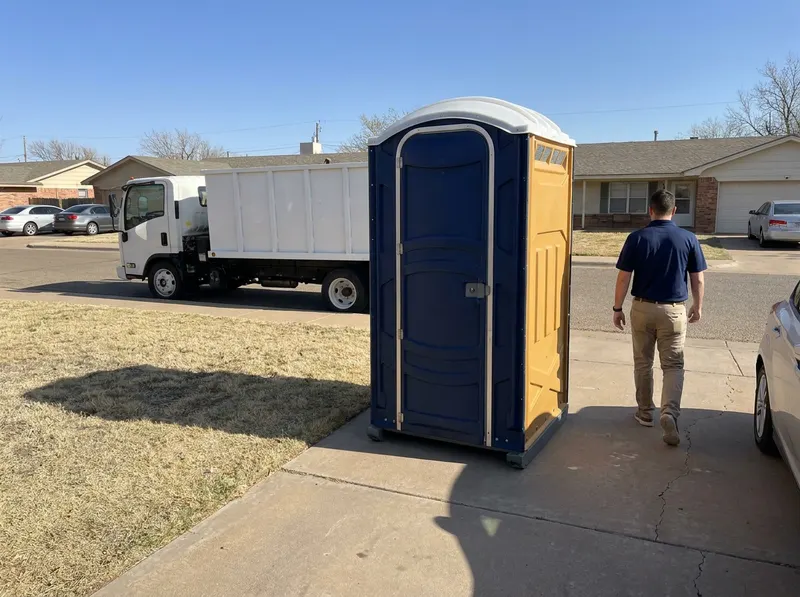
One standard unit covers roughly 10 workers on a 40-hour week with weekly service. Push past that — 15 or 20 people on a slab pour, or a two-shift stretch — and the tank fills before the service truck comes back around, which is exactly how a unit goes foul mid-week. The honest math is crew size × days, and we would rather add a second unit or a mid-week extra service visit up front than have a foreman calling on Thursday. For events, plan closer to one standard unit per 75-100 guests over a four-hour window, more if alcohol is served or the event runs past dark.
Standard versus the alternatives comes down to what the site needs, not what sounds nicer. A standard non-flush unit is the right call for construction, fencing, roofing, farm and field work, road crews, and casual outdoor gatherings — it costs the least, needs no water hookup, and can sit on caliche, dirt, gravel, or turf. Step up to a flushing or hand-wash-equipped unit when guests are in dress clothes, when a wedding coordinator wants the restrooms photographed nowhere near a blue box, or when a client-facing site expects more. Step up to an ADA-accessible unit when a public event or an inspected commercial jobsite requires accessible facilities. The trade-off is straightforward: the standard unit is the cheapest reliable option, and it looks like what it is.
Placement matters more in Lubbock than in most markets. Wind out of the southwest regularly gusts hard enough to walk an unanchored unit across an open lot, so ours get staked or ballasted at delivery, and we prefer a spot backed against a fence line, stack of material, or building corner rather than the middle of an exposed pad. Summer heat drives odor, so shaded placement and on-schedule pump-outs do more for a unit than any amount of extra deodorizer. Access varies by neighborhood: infill builds in Tech Terrace and South Overton often mean tight alley approaches and low tree limbs, so we need to know if the alley is clear; North Overton apartment and mixed-use projects usually have curb space but restricted hours; new construction in Vintage Township and Bell Farms is easy truck access but muddy after a storm; older streets in Guadalupe, Arnett Benson, and Chatman Hill can have narrow drives and parked-car pinch points. Tell us on the booking call and the driver plans around it.
We deliver standard units across Lubbock County and the surrounding towns, including field roads and caliche turnarounds where a service truck needs room to back and swing — Shallowater, Idalou, Wolfforth and similar runs are mapped delivery zones, not special favors. Park events near Maxey Park, Melonie Park, and Mackenzie Park typically need a permitted or coordinator-approved placement spot; give us that spot and we will hit it. Cotton harvest and spring construction pushes demand up sharply, so units for late-season farm work and fall events book faster than most callers expect. If a unit gets knocked over on a windy day or a heavy-use shift fills it early, call (806) 450-9912 and we schedule a service run — that is what the schedule is for. Delivered on time. Serviced on schedule.
Every job gets a firm, written price after a free on-site visit.
Tell us about your standard portable toilet rental job in Lubbock and we'll send a clear, written quote — usually the same day.
 MetroFlow Potty Exparts