Choose an accessible unit when the public can attend or when your crew includes anyone who cannot use a standard step-up restroom. Public and ticketed events in Lubbock — a festival on the lawn near the Buddy Holly…
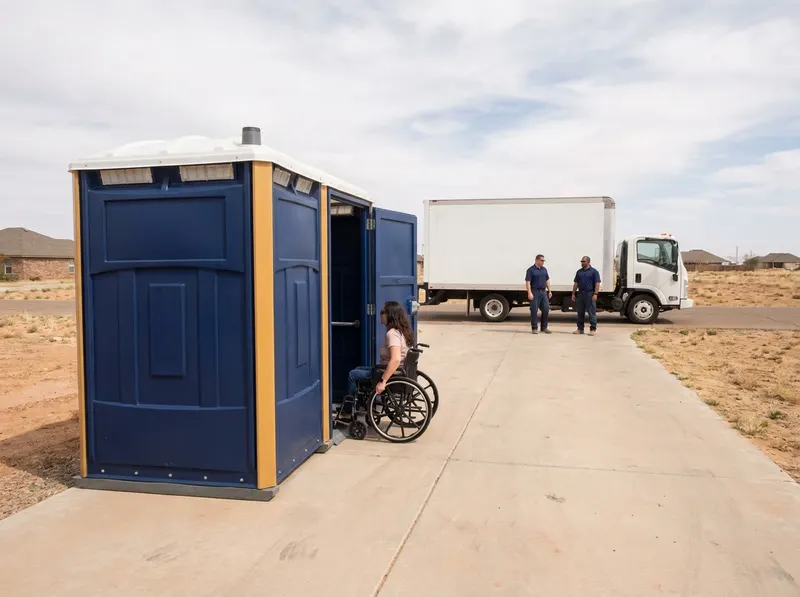
Choose an accessible unit when the public can attend or when your crew includes anyone who cannot use a standard step-up restroom. Public and ticketed events in Lubbock — a festival on the lawn near the Buddy Holly Center, a 5K staging in Mackenzie Park, an outdoor reception at Vintage Township, a fundraiser using overflow space around the Lubbock Memorial Civic Center — are generally expected to provide accessible facilities, and the benchmark planners commonly use is at least one accessible unit per bank of standard restrooms, or about 5% of total units. On jobsites, general contractors and inspectors working large projects in North Overton or on Texas Tech University-adjacent builds increasingly write an accessible unit into the site sanitation plan up front, which is cheaper than adding one mid-project.
The trade-off is footprint and access, not cost. A standard unit needs about 4 by 4 feet and can be wedged into a tight side yard in Tech Terrace or South Overton. An accessible unit needs a clear, firm, level pad roughly 5 by 5 feet plus a clean approach path — no curb lip, no soft turf, no 3-inch gravel drop-off. Grass and loose caliche are workable, but the entry must be flush, so tell us the surface when you book and we bring the unit in on a route that can support it. On residential streets in Arnett Benson, Guadalupe, or Chatman Hill where the alley is the only approach, we confirm width before delivery day rather than discovering it with a truck already on site.
West Texas conditions drive two specifics that matter more on accessible units than standard ones. First, wind: the larger door and taller wall area catch a spring gust off the Caprock, so accessible units get staked or ballasted, and we prefer a placement with a windbreak — a building wall, fence line, or trailer — with the door oriented out of the prevailing southwest flow. Second, heat and dust: a sealed unit sitting in August sun near Melonie Park or Bell Farms holds odor, so we set service frequency by actual use, not by a default weekly box, and add a deodorizer treatment on high-traffic days.
Placement also decides whether the unit gets used. An accessible restroom parked at the far end of a lot past a curb ramp is technically on site and functionally useless. We ask where the accessible parking, entry, and seating are, then set the unit on the same level path — often near a Maxey Park pavilion approach, a paved lot edge, or a jobsite gate with a graded entrance. For events running past dark, tell us and we'll advise on lighting the approach.
Pricing is a ballpark until someone looks at the ground. Delivery, pickup, and the scheduled servicing described in your quote are stated as one figure, and anything outside it — an extra service run after a heavy-use day, a relocation on site, a hard-to-reach field placement toward Wolfforth, Idalou, or Shallowater — is quoted before it happens, not added afterward. Exact pricing is confirmed on a free on-site visit or from a clear description of the surface and access route. Minimum charge is $250. Call (806) 450-9912.
Every job gets a firm, written price after a free on-site visit.
Tell us about your ada-accessible portable toilet rental job in Lubbock and we'll send a clear, written quote — usually the same day.
 MetroFlow Potty Exparts